There's a moment, just as you climb down the last stone steps, when the light changes: the heat dissolves and a mirror of fresh water appears, so transparent the tree roots seem to float in midair. That's a cenote — and the Yucatán Peninsula hides thousands of them. Best of all, some of the most beautiful ones sit less than an hour from Cancún, perfect for a day trip.
What is a cenote (and why the peninsula has so many)
The word comes from the Mayan dzonot, meaning something like "sacred well." Geologically, a cenote is a sinkhole: a natural cavity in the limestone that fills with groundwater filtered over centuries. Because nearly all of Yucatán's bedrock is porous limestone, there are no rivers on the surface; the water flows underneath, through a network of flooded caves that ranks among the largest on the planet. For the ancient Maya, these wells were the only source of fresh water — and, at the same time, sacred portals to the underworld.
Today three basic types are recognized, and it's worth knowing them before choosing which one to visit:
- Open: fully exposed to the sky, with sunlight pouring in and vegetation draping over the water. The most photogenic.
- Semi-open: partially covered by rock, with beams of light slipping through the openings. Cool and generously shaded.
- Cavern: underground, with stalactites, half-light, and a silence that feels almost like a temple. Ideal for snorkeling.
The Ruta de los Cenotes: the closest option to Cancún
If you want the most direct option for a day trip, the Ruta de los Cenotes — the Route of the Cenotes — is the answer. It's a jungle corridor that starts near Puerto Morelos, between Cancún and Playa del Carmen, and cuts inland along a road of about 30 kilometers toward Leona Vicario. That stretch concentrates dozens of cenotes of every type, plus ziplines, kayaks, and local roadside eateries. In 2019 the route was named Mexico's Best Adventure Destination at the World Travel Awards — and it's easy to see why.
Among the names that come up again and again are Cenote Verde Lucero, an open cenote with jade-colored water where you'll often see people leaping from the platforms or flying across on a zipline; Siete Bocas, a cavern with several openings in the rock that let columns of light pour through; and Boca del Puma or Las Mojarras, which pair nature with activities for families. Most are about 45 to 60 minutes by car from the Hotel Zone, which makes them ideal for an early start and a return in time for dinner.
Gems a little farther south, in the Riviera Maya
If you don't mind driving a bit longer — between an hour and an hour and a half — the area around Tulum holds some of Mexico's most celebrated cenotes. Dos Ojos is practically an icon: two lagoons connected by an underwater passage, with water so clean that snorkeling feels like floating in glass. Gran Cenote, on the road to Cobá, is perfect for a first dip because it combines open and cavern sections, with turtles gliding among the roots. And Cenote Cristalino or Cenote Azul, near Playa del Carmen, make easy, refreshing stops if you're passing through.
There's no need for an endless checklist. For a single day, it's enough to pick one or two cenotes close to each other and give them your time, unhurried. Racing through three or four usually ends in a blurry memory of lines and parking lots. The magic of a cenote lies in lingering: floating on your back, listening to the drip of the rock, letting the water do its work. That same calm is what we chase at the hotel when we talk about wellness and nature.
What to pack and how to care for the ecosystem
Cenotes are fragile. The water you're enjoying today may have taken decades to filter down, and everything that goes in with you stays in the system. The golden rule is simple: what the rock took centuries to build, we can protect in a single day. So pack your bag with intention.
- Biodegradable sunscreen (oxybenzone-free). Many cenotes ask you to shower before entering precisely to keep the water clean; conventional sunscreens are banned.
- A quick-dry towel and a change of clothes for the ride back.
- Water shoes or sandals with good grip: limestone is slippery.
- Water, cash, and little else. Many entrances are rural, and card terminals aren't a given.
- A life vest if you're not a confident swimmer; in cavern cenotes it's highly recommended.
Skip lotions, shimmery tanning oil, and insect repellent right before you get in. Don't touch the stalactites — they grow about a centimeter every hundred years — and don't take "souvenirs" from the site. Small gestures that keep the water as clear as you found it.
The best time to go
To dodge the heat, the crowds, and the tour buses, aim to arrive at opening time, usually early in the morning. In low light, open cenotes look greener and the sunbeams cutting into the caverns are more dramatic. Weekdays are always quieter than weekends. If the afternoon is your only window, choose semi-open or cavern cenotes: they offer shade and stay cool even under a strong sun. And check the forecast — after heavy rain, the water in some open cenotes can turn cloudy for a day or two.
Your own private cenote, in the heart of Cancún
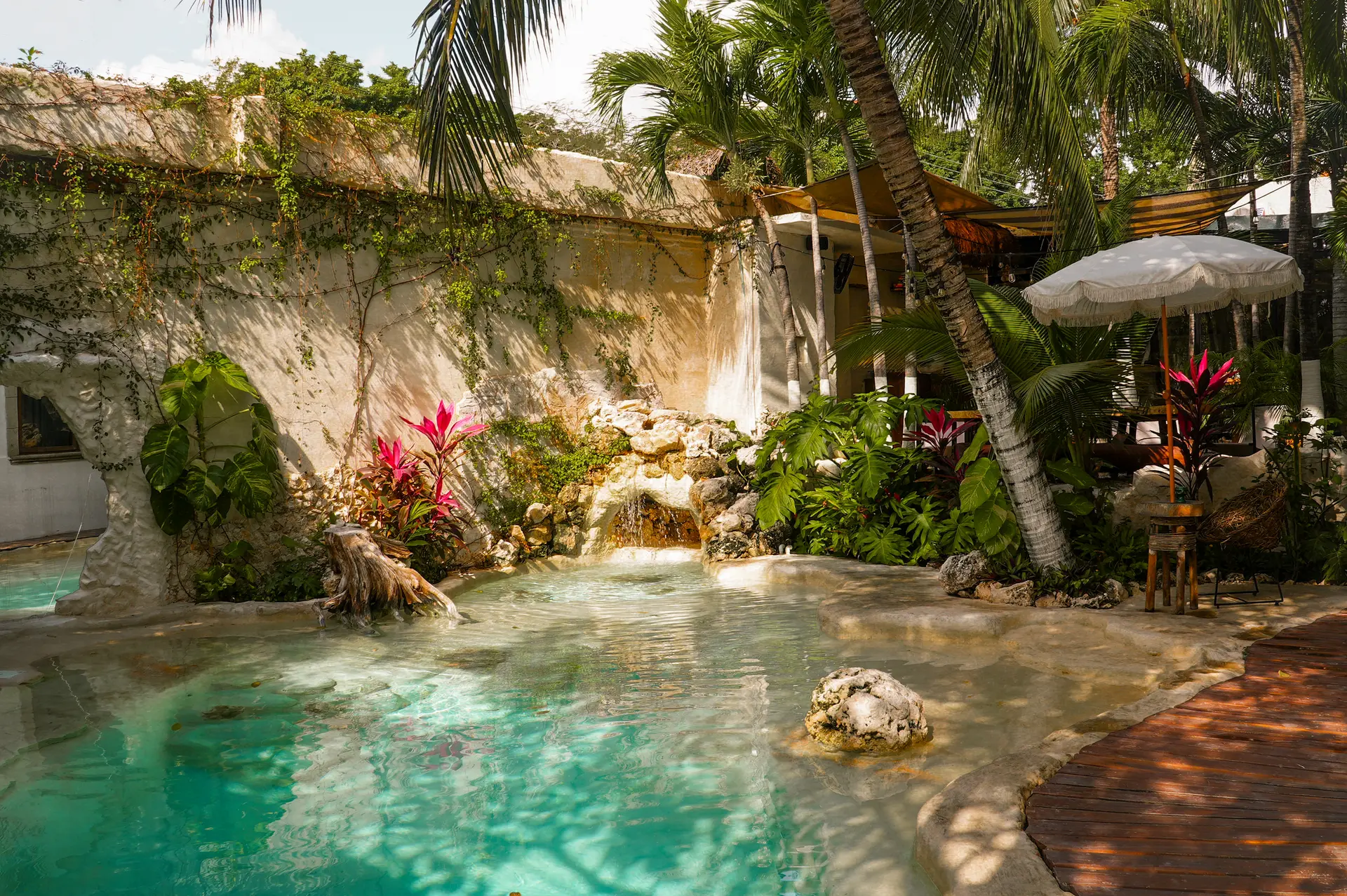
After a day of highways and fresh water, the last thing you want is to lose the ride home to Hotel Zone traffic. That's why so many guests choose to stay in downtown Cancún, on Avenida Carlos Nader: you're close to the roads out to Puerto Morelos and the Riviera Maya, yet steps from the real life of the city. And when you return, our cenote-style pool is waiting — a mirror of cool water with a waterfall and hanging jungle that recreates that same magic without leaving the hotel.
We imagined the hotel as a jungle within the city: biophilic design, green shade, and corners made for doing absolutely nothing. The cenote pool is the perfect prelude to your adventure and the ideal close to the day. If you can already picture yourself hopping from cenote to cenote and coming home to float beneath the palms, book your getaway directly with us for the best rate.


